Growing up in the US, I’ve always been told I can be anything I want to be. As a kid, I played soccer and learned karate and took piano lessons. I made a self-toothpasting toothbrush for the 4th grade invention fair and competed against boys in history day and debate competitions. I learned how to drive a car and went to college. And I did most of it while wearing pants, despite the fact that I’m a girl.
American women of my generation don’t generally see their gender as a handicap. Sure, statistically women still make less money than men in the corporate world, and there’s that whole biological baby-making thing that separates us from men, but most Americans women don’t view themselves as inherently inferior to men. Most American MEN don’t assume they’re inherently superior to women. We don’t define ourselves in relation to our fathers or our husbands, we sign our own official documents, and it’s been several decades since any woman has happily been called “Mrs. [husband’s name].”
But here in Africa it’s a different story…
When I tell Africans that I’m 24, single, and childless, they pity me. They don’t care that I graduated college with honors, that I’ve accomplished a lot of things professionally, or that I’m happy with my life. I am a childless, husbandless failure of a woman—a failure who insists on wearing the clothes of men and refuses to cover her hair. When I enrolled for my courses abroad in South Africa, because I’m female the university enrollment forms required the signature of my father or, in the case that my father was dead, my paternal grandfather or brother—NOT my mother or the gender neutral “parent or guardian.” (Sorry Dad, I forged your signature…but technically I, too, am J. Amos.)
I’ve written before about the frustration of gender inequalities in both Swaziland and Tanzania. I’ve told stories of spousal abuse and corporal punishment, of girls who have no time for homework because their fathers and brothers expect them to wash clothes and cook meals for them, of smart girls whose post-graduation plans are limited to marriage and motherhood, and of a hundred other manifestations of gender inequality that I witness every day.
Now, as I spend my every morning studying the intricacies of the Swahili language, I’m realizing that even the language is sexist. Sure, Romance languages have masculine and feminine nouns, and there are gender-specific words in English, too, that have somewhat sexist connotations. Feminist linguists argue that words like “human,” “mankind,” and even “woman” are sexist, and at weddings the bride is still symbolically “given away” by her father to her new husband. But Kiswahili takes it to a whole new level, particularly as the language relates to marriage and relationships.
For example, when asking someone if they’re married in Kiswahili, the question depends on the gender of the person you’re asking. To a man, you ask, “Umeoa?” which literally means “Are you married?” To a woman, you ask, “Umeolewa?” which translates to “Have you been married by someone?” The verb that means “to marry” is active for men and passive for women, so men marry and women are the victims of marriage. If someone asks an unmarried woman if she is married, her answer translates as “I am not yet married,” and it’s improper to answer without the “yet” part. But men are simply “not married.”
In divorce, the language is similarly one-sided. The verb “kuacha” means to throw out, to drop, or to leave behind. It also describes what a man does to a woman when he no longer wants to be married to her (aka divorce), but it cannot be done by a woman. Essentially, when a couple divorces in Kiswahili, the man throws away his wife and the woman is thrown away by her husband—even if the woman legally initiates the divorce proceeding, which is rare but allowed in all of East Africa. The woman then becomes an “mke aliyeachewa,” or “woman who has been thrown away by someone” (aka divorcee), but the man simply becomes single again—there is no word to describe a man who is no longer married.
The linguistic inequality, I think, stems from the centuries old legal arrangement of wives being the property of their husbands—a notion that very few modern American woman would agree with, but that still holds true in many developing countries. Similarly, children are the property of their fathers, not their mothers. (This also happens in the US when, by default, children are given their father’s last name, but today it’s really the choice of the mother.) In the Tanzanian National Anthem, the second verse thanks God for blessing Tanzania and for blessing “the wives of men and their children.” NOT women, men and children—the wives who belong to the men, and the children who belong to the men. Apparently nobody cares whether or not God blesses unmarried women.
And maybe this is something that will change in a generation’s time, like it did in the Western world, after girls start going to college and women start getting top jobs in the corporate world or government and start demonstrating their competency outside the realm of cooking, cleaning, and child rearing. Until then, I’ll be frustrating my Kiswahili teacher by making the language of marriage and divorce gender neutral by using a reciprocal verb suffix—“kuoana” (to marry one another) and “kuacha” (to divorce one another)—even though I know it’s technically incorrect. For now, at least.
Tuesday, December 7, 2010

Mosquito nets, malaria prevention, and the challenge of public health.
PSI, a US-based NGO that promotes family planning and disease prevention internationally, set up a malaria education/prevention station a couple blocks from my house last week. With funding from the Global Fund to Prevent TB & Malaria and USAID (that’s YOUR tax dollars at work), they distributed free insecticide-treated bed nets to all families with children under the age of 5 and hundreds of malaria prevention pamphlets that are now half-buried in the muddy streets of the neighborhood. In the last decade, programs like this one have reduced the number of malaria-related deaths in children by the millions, but after several years of seeing these programs implemented in Africa, and after discussing the logistics of PSI’s campaign with my Kiswahili teachers, I can’t help but wonder how much more successful such programs would be if the people designing them had a better understanding of the culture of the country in which they’re working.
From an American perspective, we think that by giving people the education and resources they need to prevent themselves from getting a disease, they’ll do it. If we distribute mosquito nets to families and tell them these nets will keep their kids from dying of malaria, they’ll use them. Right? Unfortunately it’s not that simple, for a number of reasons:
1. Since the Global Fund is focusing on preventing disease in children, all the nets PSI distributes are for child-sized beds. This would work in the US, where babies sleep in bassinets and cribs and twin-sized beds, but most African under-5’s sleep in a full-sized bed with their parents or siblings. A crib-sized net is pretty much useless here.
2. Many African families sleep on foam mattresses or grass mats on the floor of a one-room house. During the day, the beds are stacked against the wall and these rooms are used for cooking, bathing, radio listening, tea drinking, homework doing, and a hundred other daily activities, so permanently installing a insecticide-stinking mosquito net in the middle of the room isn’t exactly practical. (In fact, it’s probably a fire hazard.) And taking it down and putting it back up every day gets old really quick.
3. The nets aren’t distributed with the hardware and/or ropes needed to hang them, and most families don’t have these things just lying around. Four little hooks and enough rope to hang a single net cost about 25% of an average family’s monthly income. Who can afford that?
4. There’s no way to ensure that the people receiving the nets actually need them. Families that received free nets last year collected new nets again this year, and there’s no way to prove that someone who says they have a 2-year-old doesn’t actually have a 2-year-old. Since many children are born at home, there’s no master list of all children under the age of 5, and many children aren’t counted by any government registry until they enroll in the first grade. Basically, anybody who wants a net gets a net. Or two.
5. Mosquito nets have considerable market value so many families sell them. Hotels constantly need new nets for their malaria-fearing foreign guests who expect clean, hole-less nets over their beds. Dress-makers use the tulle-like netting as a lining for dresses. Fishermen double up the netting to make low cost fishing nets. And others are just re-sold as is to the net-needing public at the local market, which is how I ended up with my not-free PSI/USAID mosquito net.
6. Treatment for malaria is widely available and 100% free courtesy of USAID, WHO, and other organizations. At any hospital or clinic, children and adults with malaria or malaria-like symptoms gets chloroquine or primiquine, usually with a free overnight stay in a warm, comfy bed and a couple of meals. So why bother prevent it when you can treat it just as easily, plus perks?
I can’t help but wonder if there’s a better way to prevent malaria in Africa. If PSI gave out full-sized nets, how many more malaria-related deaths would be prevented? If the nets came with a couple yards of rope, would more people hang them? If PSI distributed them door-to-door, would fewer nets be given to families that already have nets? If nets were given to new mothers at the hospital or clinic after birth or when the child is brought in for his first vaccinations, would the number of nets distributed more accurately match the number of infants in the country? If retailers found to be re-selling free nets were punished in some way, would they think twice about re-selling the nets? If parents had to pay for malaria treatment, would they try harder to protect their kids from it in the first place?
Most importantly, does the benefit of this kind of mosquito net distribution outweigh the faults of the program and warrant its continuation? I think so.
No public health program implemented in the developing world (or anywhere, really) is 100% effective. The eradication of polio is most often cited as an example of a successful public health initiative, but 10 minutes in any African city full of polio-crippled beggars will prove that polio hasn’t been eradicated. But if the alternative to a program that reduces new infections of HIV by 5% is no program at all, isn’t that 5% still worth working for?
I found myself asking a similar question a few years ago when I was working for A Wider Circle, a fantastic DC-based non-profit that provides nutrition education, after school programs, job training, and furniture to low-income families in DC, Maryland, and Virginia. Day after day I taught low-income seniors how to make heart-healthy fruit smoothies and helped Hurricane Katrina refugees move free furniture from Bethesda demi-mansions into their tiny FEMA-subsidized apartments, and I felt like it was worth it.
But I remember one Saturday morning when a woman with a Baby Phat track suit and a fancy cell phone rolled up in her big black Escalade, a flock of Nike- and Roca Wear-clad children in tow. We helped her load her new bedroom set into her Escalade and strapped a brand new mattress to the roof, reserved for her a dining room set and big color TV, and sent her off with a big bag of day-old high end pastries from a Georgetown bakery. The other volunteers and I couldn’t help feeling taken advantage of. Were we giving up our Saturday mornings to give free things to selfish pseudo-poor people in expensive clothes? If a woman driving an Escalade could get a free queen-sized mattress from an NGO, why was I sleeping on a broken-down twin mattress on the floor of a walk-in closet?
Mark, the organization’s director, was the only one who was still smiling. He asked us, “If 99% of the families we help actually need the help we give them, is it worth putting up with the other 1% who are like that woman?” We agreed that it was. “What if 25% of the people we help are like her, and only 75% actually need the help. Should we keep working?” Sure, we said—those 75% of families are still better off than they would be without our help. “What if 95% of the people we help are like her and only 5% actually needs us?” By our own logic, that’s still 5% of families that are better off because of our work, so we should keep working. But what’s the threshold?
With any project intended to help people, there’s going to be failures. Selfish people who don’t need help will get free stuff, and people who actually need help will be overlooked. Mosquito nets that are intended to protect a child from malaria will be sold so his mother can buy new shoes or pay school fees, and when the child gets sick his new shoe-wearing mother will take him to the hospital for free treatment. Where there’s free stuff, there’s someone waiting to take advantage. But there are also people whose lives can be saved by free food, and children whose lives can be improved by free health care, so shouldn’t we keep providing it? The only alternative is to deny help to EVERYBODY, which punishes the freeloaders of the world by refusing to help people who actually need it. That’s not really fair either, is it?
Even if the world will never be FAIR, I hope that the work that NGOs and aid agencies and I myself do at least helps make life little less UNFAIR. That’s reason enough to keep distributing mosquito nets, to keep learning a seemingly useless African language, to keep trying, right? I think so.
From an American perspective, we think that by giving people the education and resources they need to prevent themselves from getting a disease, they’ll do it. If we distribute mosquito nets to families and tell them these nets will keep their kids from dying of malaria, they’ll use them. Right? Unfortunately it’s not that simple, for a number of reasons:
1. Since the Global Fund is focusing on preventing disease in children, all the nets PSI distributes are for child-sized beds. This would work in the US, where babies sleep in bassinets and cribs and twin-sized beds, but most African under-5’s sleep in a full-sized bed with their parents or siblings. A crib-sized net is pretty much useless here.
2. Many African families sleep on foam mattresses or grass mats on the floor of a one-room house. During the day, the beds are stacked against the wall and these rooms are used for cooking, bathing, radio listening, tea drinking, homework doing, and a hundred other daily activities, so permanently installing a insecticide-stinking mosquito net in the middle of the room isn’t exactly practical. (In fact, it’s probably a fire hazard.) And taking it down and putting it back up every day gets old really quick.
3. The nets aren’t distributed with the hardware and/or ropes needed to hang them, and most families don’t have these things just lying around. Four little hooks and enough rope to hang a single net cost about 25% of an average family’s monthly income. Who can afford that?
4. There’s no way to ensure that the people receiving the nets actually need them. Families that received free nets last year collected new nets again this year, and there’s no way to prove that someone who says they have a 2-year-old doesn’t actually have a 2-year-old. Since many children are born at home, there’s no master list of all children under the age of 5, and many children aren’t counted by any government registry until they enroll in the first grade. Basically, anybody who wants a net gets a net. Or two.
5. Mosquito nets have considerable market value so many families sell them. Hotels constantly need new nets for their malaria-fearing foreign guests who expect clean, hole-less nets over their beds. Dress-makers use the tulle-like netting as a lining for dresses. Fishermen double up the netting to make low cost fishing nets. And others are just re-sold as is to the net-needing public at the local market, which is how I ended up with my not-free PSI/USAID mosquito net.
6. Treatment for malaria is widely available and 100% free courtesy of USAID, WHO, and other organizations. At any hospital or clinic, children and adults with malaria or malaria-like symptoms gets chloroquine or primiquine, usually with a free overnight stay in a warm, comfy bed and a couple of meals. So why bother prevent it when you can treat it just as easily, plus perks?
I can’t help but wonder if there’s a better way to prevent malaria in Africa. If PSI gave out full-sized nets, how many more malaria-related deaths would be prevented? If the nets came with a couple yards of rope, would more people hang them? If PSI distributed them door-to-door, would fewer nets be given to families that already have nets? If nets were given to new mothers at the hospital or clinic after birth or when the child is brought in for his first vaccinations, would the number of nets distributed more accurately match the number of infants in the country? If retailers found to be re-selling free nets were punished in some way, would they think twice about re-selling the nets? If parents had to pay for malaria treatment, would they try harder to protect their kids from it in the first place?
Most importantly, does the benefit of this kind of mosquito net distribution outweigh the faults of the program and warrant its continuation? I think so.
No public health program implemented in the developing world (or anywhere, really) is 100% effective. The eradication of polio is most often cited as an example of a successful public health initiative, but 10 minutes in any African city full of polio-crippled beggars will prove that polio hasn’t been eradicated. But if the alternative to a program that reduces new infections of HIV by 5% is no program at all, isn’t that 5% still worth working for?
I found myself asking a similar question a few years ago when I was working for A Wider Circle, a fantastic DC-based non-profit that provides nutrition education, after school programs, job training, and furniture to low-income families in DC, Maryland, and Virginia. Day after day I taught low-income seniors how to make heart-healthy fruit smoothies and helped Hurricane Katrina refugees move free furniture from Bethesda demi-mansions into their tiny FEMA-subsidized apartments, and I felt like it was worth it.
But I remember one Saturday morning when a woman with a Baby Phat track suit and a fancy cell phone rolled up in her big black Escalade, a flock of Nike- and Roca Wear-clad children in tow. We helped her load her new bedroom set into her Escalade and strapped a brand new mattress to the roof, reserved for her a dining room set and big color TV, and sent her off with a big bag of day-old high end pastries from a Georgetown bakery. The other volunteers and I couldn’t help feeling taken advantage of. Were we giving up our Saturday mornings to give free things to selfish pseudo-poor people in expensive clothes? If a woman driving an Escalade could get a free queen-sized mattress from an NGO, why was I sleeping on a broken-down twin mattress on the floor of a walk-in closet?
Mark, the organization’s director, was the only one who was still smiling. He asked us, “If 99% of the families we help actually need the help we give them, is it worth putting up with the other 1% who are like that woman?” We agreed that it was. “What if 25% of the people we help are like her, and only 75% actually need the help. Should we keep working?” Sure, we said—those 75% of families are still better off than they would be without our help. “What if 95% of the people we help are like her and only 5% actually needs us?” By our own logic, that’s still 5% of families that are better off because of our work, so we should keep working. But what’s the threshold?
With any project intended to help people, there’s going to be failures. Selfish people who don’t need help will get free stuff, and people who actually need help will be overlooked. Mosquito nets that are intended to protect a child from malaria will be sold so his mother can buy new shoes or pay school fees, and when the child gets sick his new shoe-wearing mother will take him to the hospital for free treatment. Where there’s free stuff, there’s someone waiting to take advantage. But there are also people whose lives can be saved by free food, and children whose lives can be improved by free health care, so shouldn’t we keep providing it? The only alternative is to deny help to EVERYBODY, which punishes the freeloaders of the world by refusing to help people who actually need it. That’s not really fair either, is it?
Even if the world will never be FAIR, I hope that the work that NGOs and aid agencies and I myself do at least helps make life little less UNFAIR. That’s reason enough to keep distributing mosquito nets, to keep learning a seemingly useless African language, to keep trying, right? I think so.
Corruption and the clash of cultures at the Iringa Regional Immigration Office
94 days ago I got a 90 day visa for a 108 day long stay in Tanzania. Standing at the immigration counter in the Dar Es Salaam airport, sweating profusely and exhausted from fourteen hours of travel, this 18 day discrepancy seemed much less important than taking a cold shower and finding a horizontal place suitable for sleeping. I didn’t worry about it again until about a month ago, when I paid my first visit to the regional immigration office in Iringa.
On my first visit the official on duty told me I didn’t need another visa, despite the fact that my current one would expire 18 days before my flight back to Swaziland; he recommended that I overstay my visa and beg forgiveness at the airport. The next week I went back in search of a more legal answer and was told I could either get a $200 student visa or spend a weekend in Malawi and renew my multiple entry visa by default at the border. On my third visit, after explaining my situation the official launched into a tirade about the theft of culture, which I was clearly guilty of. I smiled, nodded, and pretended to be listening while contemplating the feasibility of a weekend trip to Malawi.
But it got me thinking about the export of culture. For better or worse the internet, cell phones, television, air travel, and technology in general have made the world a much smaller place than it was just a decade ago. Fashion trends, political systems, religion, language, music, cuisine— things once confined to a specific country or culture are now available throughout the world. Many African radio stations broadcast American Evangelists’ sermons and programs like “Focus on the Family,” and in the afternoon every TV in Tanzania is tuned into Spanish soap operas dubbed into English with Swahili subtitles. Muslim women in Zanzibar have Gmail accounts. Swazi grocery stores sell Danish butter cookies made in Dubai and Kellog’s Corn Flakes, and just about everybody wants to learn English. While accusing me of the intellectual theft of his mother tongue, the angry immigration official was wearing dark wash Levi’s with a big knock-off Calvin Klein belt buckle and making notes with a Bic pen imported from Thailand by a South African company.
But even more than dark wash jeans and corn flakes, what amazes (and sometimes appalls) me is the IDEAS that are exported together with all of these THINGS. In Swaziland, people who watch the TV broadcast of the American Bishop T.D. Jakes’ sermon think that America is full of racist Christian fundamentalists; Swazis who watch WWE wrestling think all American women have gigantic boobs encased in vinyl like big pornographic sausages, and that all American men have funny mustaches and fight each other with folding chairs while wearing spandex. A Tanzanian woman who had seen an episode of MTV’s “Cribs” featuring the ridiculous mansion and car collection of the rapper 50 Cent asked me how many Lamborghinis my parents owned, and I have a really hard time convincing people that not everybody in America is white and wealthy. A couple months ago, when walking down the street in wide leg jeans and a ribbed tank top, an older Muslim woman asked me why I was “wearing the uniform of the prostitute,” because clearly anyone who wears pants is a hooker. The understanding of American culture that’s exported around the world is that we’re all gluttonous, wasteful fatties with mattresses stuffed with Dollars where we sleep with a different partner every night and talk about how much we hate Black people.
Every day I spend in Africa I find myself fighting this perception of Americans. Countless times, I’ve explained that not all Americans are White or rich or wear suits to work every day. I’ve explained that not all Americans are Christian, and that American culture is not monolithic; that the US is a country of immigrants and diversity and multiple political parties and socio-economic classes. I’ve tried to explain that if I knew a bunch of multi-millionaires eager to fund the higher education of strangers I wouldn’t be spending my weekends writing essays for scholarship applications, and I try to dispel myths of selfishness and gluttony through my behavior. But as I compete with the TV shows like “Cops,” bags of free food labeled “Aid from the American people,” and the ridiculously short skirts of celebrities in the Entertainment section of the newspaper, sometimes it feels like a losing battle.
In my immigration office standoff, though, I was victorious. After several return trips and many hours of practicing the argumentative tense of Kiswahili, the Regional Immigration Director locked my passport in his desk drawer and demanded that I pay him $100 to get it back. I pulled my other passport out of my bag (I have 2—one that Peace Corps gave me and my personal one) and shrugged off his threat as I showed myself to the door. Ten minutes later, I had a free 30 day visa extension and a mug of sugary tea and biscuits. And now at least one immigration official in Tanzanian knows that Americans are smart, persistent and refuse to pay bribes. Even while wearing a prostitute uniform. That’s me doing my part.
On my first visit the official on duty told me I didn’t need another visa, despite the fact that my current one would expire 18 days before my flight back to Swaziland; he recommended that I overstay my visa and beg forgiveness at the airport. The next week I went back in search of a more legal answer and was told I could either get a $200 student visa or spend a weekend in Malawi and renew my multiple entry visa by default at the border. On my third visit, after explaining my situation the official launched into a tirade about the theft of culture, which I was clearly guilty of. I smiled, nodded, and pretended to be listening while contemplating the feasibility of a weekend trip to Malawi.
But it got me thinking about the export of culture. For better or worse the internet, cell phones, television, air travel, and technology in general have made the world a much smaller place than it was just a decade ago. Fashion trends, political systems, religion, language, music, cuisine— things once confined to a specific country or culture are now available throughout the world. Many African radio stations broadcast American Evangelists’ sermons and programs like “Focus on the Family,” and in the afternoon every TV in Tanzania is tuned into Spanish soap operas dubbed into English with Swahili subtitles. Muslim women in Zanzibar have Gmail accounts. Swazi grocery stores sell Danish butter cookies made in Dubai and Kellog’s Corn Flakes, and just about everybody wants to learn English. While accusing me of the intellectual theft of his mother tongue, the angry immigration official was wearing dark wash Levi’s with a big knock-off Calvin Klein belt buckle and making notes with a Bic pen imported from Thailand by a South African company.
But even more than dark wash jeans and corn flakes, what amazes (and sometimes appalls) me is the IDEAS that are exported together with all of these THINGS. In Swaziland, people who watch the TV broadcast of the American Bishop T.D. Jakes’ sermon think that America is full of racist Christian fundamentalists; Swazis who watch WWE wrestling think all American women have gigantic boobs encased in vinyl like big pornographic sausages, and that all American men have funny mustaches and fight each other with folding chairs while wearing spandex. A Tanzanian woman who had seen an episode of MTV’s “Cribs” featuring the ridiculous mansion and car collection of the rapper 50 Cent asked me how many Lamborghinis my parents owned, and I have a really hard time convincing people that not everybody in America is white and wealthy. A couple months ago, when walking down the street in wide leg jeans and a ribbed tank top, an older Muslim woman asked me why I was “wearing the uniform of the prostitute,” because clearly anyone who wears pants is a hooker. The understanding of American culture that’s exported around the world is that we’re all gluttonous, wasteful fatties with mattresses stuffed with Dollars where we sleep with a different partner every night and talk about how much we hate Black people.
Every day I spend in Africa I find myself fighting this perception of Americans. Countless times, I’ve explained that not all Americans are White or rich or wear suits to work every day. I’ve explained that not all Americans are Christian, and that American culture is not monolithic; that the US is a country of immigrants and diversity and multiple political parties and socio-economic classes. I’ve tried to explain that if I knew a bunch of multi-millionaires eager to fund the higher education of strangers I wouldn’t be spending my weekends writing essays for scholarship applications, and I try to dispel myths of selfishness and gluttony through my behavior. But as I compete with the TV shows like “Cops,” bags of free food labeled “Aid from the American people,” and the ridiculously short skirts of celebrities in the Entertainment section of the newspaper, sometimes it feels like a losing battle.
In my immigration office standoff, though, I was victorious. After several return trips and many hours of practicing the argumentative tense of Kiswahili, the Regional Immigration Director locked my passport in his desk drawer and demanded that I pay him $100 to get it back. I pulled my other passport out of my bag (I have 2—one that Peace Corps gave me and my personal one) and shrugged off his threat as I showed myself to the door. Ten minutes later, I had a free 30 day visa extension and a mug of sugary tea and biscuits. And now at least one immigration official in Tanzanian knows that Americans are smart, persistent and refuse to pay bribes. Even while wearing a prostitute uniform. That’s me doing my part.
Saturday, November 13, 2010
Obama lovin', dresses, and smoked grasshoppers


 |
| Africa LOVES Obama. Obama chewing gum, Obama ballpoint pens, Obama backpacks. You name it, I've seen it. A couple weeks ago, I found Obama underwear at a used clothes market, complete with airbrushed Obama on the butt and a waistband that said "Commander in Chief." Still, who buys used underwear? |

 |
| It's amazing how an $8 dress with big cartoon fish on it can make me feel pretty, but it does. Fabric here is so ridiculous it's amazing. Last week I found a piece of gray and purple cloth with bright green and orange vacuums vacuuming bright yellow and blue carpets. I had to seriously restrain myself from buying it and having it made into a dress... |

 |
| On Friday, I had a toasted egg and cheese sandwich with a side of smoked grasshoppers for lunch. Yum! They're super tiny this time of year, crunchy, and taste like just about anything else that's smoked. But they look scary. |
 |
| In Swahili, L and R are interchangeable, so this actually means "Death Row." I love misspelled graffiti. |
 |
| I have developed mosquito-squashing skills of epic proportions. Gross, yes, but very necessary. |
 |
| My life is so uneventful that I take pictures of the baby papaya inside my big papaya. That's exciting to me. (Kind of a cool picture, though.) |
Monday, November 8, 2010
How I almost paid $276 for a 16-oz 7-Up
Yesterday was a typical lazy Tanzanian Sunday. I was awakened at 7:00am by the children discreetly banging on the window by my head in an attempt to wake me up so we could play. An hour later, half-way through the second showing of The Lion King in as many days, my host mother delivered a 5-gallon bucket of heavily chlorinated water from the local price-gouging water distributor (he picks up the slack when the government shuts off the neighborhood’s supply for weeks at a time). Sweet! I washed my hair for the first time in 11 days (gross, I know), threw on some reasonably clean clothes and started the 20-minute walk to town intent on some exercise and several hours of therapeutic online shoe not-buying.
After lunch, I stopped by the ATM and perusing the local market for the week’s stock of fruit and dry goods, browsing a few local wax-print fabric shops along the way. (African fabric is my kryptonite.) An hour later, tired from the hot sun, I was drawn to a tiny fabric-and-cold-drink shop on the corner of the bus rank, where I stopped for a 7-Up. Sitting down on one of the shop’s two stools, my messenger bag between my feet, I struck up a conversation with the shop’s owner and took little notice when two men walked into the shop. They dirty-fingered through the fabric hanging on the walls, and one bought a Coke and introduced himself to me. He knelt in front of me and unfolded a bright orange piece of fabric covered in yellow fish and blue flowers, mumbling something intently to his friend who was kneeling to the side of him. I returned to my conversation with the shop-keeper, sipping my awesomely cold 7-Up.
When I felt him bump my bag, my initial reaction was to reach down and move it out of his way. And then I realized that his hand was deep inside my bag, his dirty fingers wrapped around my wallet. I threw back the gaudy/fabulous fabric as he stood up, my wallet in hand. I demanded my wallet from him as he stared at me with a deer-in-the-headlights look. I lifted up my nearly empty glass 7-Up bottle like I’d seen in bar fights on TV and stared back at him menacingly while his accomplice and the shop-keeper ran out of the shop to escape the crazy white lady. Bewildered, the thief handed me back my wallet and apologized. I told him where he could go and that Jesus had seen the whole thing, stared at him with the evilest, most hateful look in my repertoire and demanded, bottle in hand, that he leave. He protested half-heartedly that he still had half a Coke left as he made his exit, and I rummaged through my bag to make sure my camera and other things were still there. (They were.) A minute later, the shop-keeper came back and apologized for abandoning me and I sat down to finish off the dregs of my 7-Up, recovering from the adrenaline rush that comes from being the almost-victim of an almost-crime and contemplating the almost-weapon in my hand.
To me, the worst thing about being robbed isn’t usually the phone or money (or the fancy Basotho blanket) or whatever I lose, it’s the feeling of being violated. In that sense, an attempted robbery is just as bad as a successful one. And I’m pretty sure those guys followed me from the bank just waiting for the perfect chance to move in, which makes the whole incident even scarier. But at least I know I can hold my own in a fabric slash soda store in the event of an attempted robbery by a pair of unarmed men, assuming I’m drinking a 7-Up. And maybe now I’ll have some sort of post-traumatic aversion to fabric stores and I’ll stop buying wax-print fabric. Probably not, but maybe.
Aside from that, my life is pretty uneventful: class every day, internet café most afternoons, homework in the evenings, and the occasional 24-hour marathon of The Office, which is what I did all day Saturday instead of writing an essay for a scholarship application. Oops.
Anyway, I’ll be home in exactly 2 months! Exciting, right? Can’t wait!
After lunch, I stopped by the ATM and perusing the local market for the week’s stock of fruit and dry goods, browsing a few local wax-print fabric shops along the way. (African fabric is my kryptonite.) An hour later, tired from the hot sun, I was drawn to a tiny fabric-and-cold-drink shop on the corner of the bus rank, where I stopped for a 7-Up. Sitting down on one of the shop’s two stools, my messenger bag between my feet, I struck up a conversation with the shop’s owner and took little notice when two men walked into the shop. They dirty-fingered through the fabric hanging on the walls, and one bought a Coke and introduced himself to me. He knelt in front of me and unfolded a bright orange piece of fabric covered in yellow fish and blue flowers, mumbling something intently to his friend who was kneeling to the side of him. I returned to my conversation with the shop-keeper, sipping my awesomely cold 7-Up.
When I felt him bump my bag, my initial reaction was to reach down and move it out of his way. And then I realized that his hand was deep inside my bag, his dirty fingers wrapped around my wallet. I threw back the gaudy/fabulous fabric as he stood up, my wallet in hand. I demanded my wallet from him as he stared at me with a deer-in-the-headlights look. I lifted up my nearly empty glass 7-Up bottle like I’d seen in bar fights on TV and stared back at him menacingly while his accomplice and the shop-keeper ran out of the shop to escape the crazy white lady. Bewildered, the thief handed me back my wallet and apologized. I told him where he could go and that Jesus had seen the whole thing, stared at him with the evilest, most hateful look in my repertoire and demanded, bottle in hand, that he leave. He protested half-heartedly that he still had half a Coke left as he made his exit, and I rummaged through my bag to make sure my camera and other things were still there. (They were.) A minute later, the shop-keeper came back and apologized for abandoning me and I sat down to finish off the dregs of my 7-Up, recovering from the adrenaline rush that comes from being the almost-victim of an almost-crime and contemplating the almost-weapon in my hand.
To me, the worst thing about being robbed isn’t usually the phone or money (or the fancy Basotho blanket) or whatever I lose, it’s the feeling of being violated. In that sense, an attempted robbery is just as bad as a successful one. And I’m pretty sure those guys followed me from the bank just waiting for the perfect chance to move in, which makes the whole incident even scarier. But at least I know I can hold my own in a fabric slash soda store in the event of an attempted robbery by a pair of unarmed men, assuming I’m drinking a 7-Up. And maybe now I’ll have some sort of post-traumatic aversion to fabric stores and I’ll stop buying wax-print fabric. Probably not, but maybe.
Aside from that, my life is pretty uneventful: class every day, internet café most afternoons, homework in the evenings, and the occasional 24-hour marathon of The Office, which is what I did all day Saturday instead of writing an essay for a scholarship application. Oops.
Anyway, I’ll be home in exactly 2 months! Exciting, right? Can’t wait!
Friday, November 5, 2010
Pictures I've been trying unsuccessfully to load for a week.
 |
| I found this chicken foot on my way home from class the other day. Gross. |
 |
| I buy milk in bags. |
 |
| I made DELICIOUS Rice Krispies Treats for my host family, but unfortunately Tanzania only has multi-colored marshmallows and all the green, yellow, and blue ones make green. (The pink seems to be irrelevant in the color mix...) |
 |
| Tall Horse Cabernet Sauvignon is my best friend. Unfortunately I find it difficult to crave wine when it's a bazillion degrees in my house, which is actually good news for my bank account because this stuff is EXPENSIVE here. |
 |
| The little shop at my school where I buy stuff during class if I'm hungry. They advertise candy bars, Pringles, Coke, Red Bull, Heinz Baked Beans, Duracell batteries, etc., but really all they sell is deep-fried doughnuts. |
 |
| Furaha means "happiness." Sometimes when I'm having a bad day, I eat a large quantity of happiness. That's a healthy response to stress. |
Friday, October 29, 2010
Democracy Shmemocracy: Party Politics in Tanzania

On the other hand, there’s Africa. Here, elections are postponed indefinitely without reason by an incumbent who fears being ousted. When long-awaited elections actually happen, sometimes people’s votes aren’t secret and the government forces are scary enough that everyone votes for the incumbent out of fear. If an incumbent leader happens to lose an election, he stays in office and appoints the actual winner of the election as Prime Minister (Kenya in 2007, Zimbabwe in 2009). Opposition candidates, party leaders and organizers, and vocal individuals who speak out against the government’s policies or management are “disappeared” (kidnapped and killed) or assassinated. And, in many countries, so-called “democratic” elections are more for show than anything, held only to prove to international donors like the US that the government is “trying” to democratize and is therefore worthy of aid. (There’s also an outside chance that a democratically elected leader will be assassinated by an outside force…like the CIA. Ex: Patrice Lumumba of the Congo in 1961.)
Tanzania is a great example of the strange incarnation of “democracy” in Africa. The country held its first post-independence election in 1961, shortly after independence from the British. In this election, Julius Nyerere was elected as the first president of Tanganyika and Zanzibar, which he combined into “The United Republic of Tanzania” (“Tan…ia” for Tanganyika and “…zanz…” for Zanzibar…get it?). Nyerere and his Chama Cha Mapinduzi (CCM, Party of the Revolution in English) wrote the constitution and established the foundation for modern politics in Tanzania, including the systematic suppression of opposition parties. Nyerere held the presidency for 24 years until the country’s first “multi-party” democratic elections in 1985. Ali Hassan Mwinyi (President 1985-1995), Benjamin Mkapa (1995-2005), and Jakaya Kikwete (2005-present) have all been member of the CCM political party, and Kikwete is expected to be re-elected again this year.
On paper, Tanzania is a democracy. The country has a democratically elected leader voted for by the entire 18-and-over population of Tanzania, and elections are held every 5 years on the last Sunday of October. Opposition parties are allowed to form and operate without official legal repercussions, and the constitution allows Tanzanians the freedom of association with any party they choose. (Currently there are two serious opposition parties: CUF and Chadema. Chadema is the largest opposition party on the mainland, and CUF on Zanzibar.) On election day, people go to the polls and vote in privacy, and votes are sealed in their boxes by officers of the law before being transported to the nearest vote-counting station. The person with the most votes takes office, the other candidates are the losers. Et cetera.
But, in practice, it’s a lot more complicated…and a lot less democratic. Voters are discouraged from registering to vote or kept from voting by tactics similar to those used on African American voters in the 1960s. The CCM uses government funds (a LOT of government funds), government airplanes, government buildings, government workers, and government media and television outlets, and other government resources to promote itself, but the CUF and Chadema have to fund their campaigns through private donations solicited largely from a population of impoverished Tanzanians. There’s even rumor (though somewhat more substantiated than rumor…) of CCM officials buying the voter registration cards of under-35’s for as little as $4 so that they can’t vote for Chadema come election day, or “losing” entire pages of registered voters names at the polling stations. (They have two sections for voting: under 35, and over 35. Since it’s under 35’s who tend to vote Chadema, by losing just one page of voters’ names it’s very easy to eliminate non-CCM votes.) In rural areas, police (who are government employees under the CCM government) intimidate uneducated voters by hinting that their safety could be jeopardized if CCM left power, and on election day they stand outside polls with their automatic weapons so that nobody forgets who holds the power. Candidates who draw attention to CCM corruption or Kikwete’s failed policies end up in jail on “treason” charges and are no longer eligible to run for office; others running for local offices mysteriously die of “natural” causes. This year, the government announced that colleges and universities (which are usually closed until after the election) would open 3 days BEFORE election day, meaning that the largely Chadema-supporting college population will be away at school instead of at home to vote on Sunday, and there’s no option like absentee voting. And then, even if all the CCM-favoring election-skewing plots prove ineffective, there’s always the fall-back option of just tampering with the votes before they’re officially counted. After all, it’s the polling station workers (hired by CCM) and police officers (hired by CCM) who are responsible for securing the votes and certifying their validity.
On Thursday afternoon I attended a Chadema (Chama Cha Demokracia na Maendeleo, or Party of Democracy and Development) political rally for Doctor Slaa, the most popular opposition presidential candidate on the mainland. Despite the fact that he never showed up (TIA, right?) and that I only understood about 40% of what various candidates yelled crazy-African-preacher-style over the loudspeaker, it was a really interesting and enlightening experience. I made friends with two high school teachers and we discussed (in Swahili!) the election, the history of Tanzania, and the platforms and promises of various parties and candidates.
At one point, I asked them if they thought Doctor Slaa would win on Sunday and they both laughed at me like I was ridiculous. They were there to show their support, they said, for any kind of non-CCM change, but it has to happen gradually. Five years ago, an opposition rally like Thursday’s NEVER would have happened. Candidates would have been afraid to speak out against CCM, and people would have been afraid to show up to such a rally for fear that their businesses or families would be harmed as a result of their participation (or just their curiosity). “Chadema isn’t campaigning for 2010, they’re campaigning for 2015. We’re all here to show other people that if they, too, can support another party and not be killed.” They said that if on Sunday they vocally vote for Chadema and then aren’t punished by the CCM, maybe their CCM-fearing friends and neighbors will consider voting for someone other than CCM in 2015.
They also laughed when I asked if Tanzania had ever had “free and fair” elections. According to the Carter Center, which monitors this kind of thing, Tanzania’s 2000 election was fair, but 2005 was rigged in favor of the CCM, and regional elections on the island of Zanzibar have never been fair. But my teacher friends (and most everyone else I talk to about it, including Tanzanians, expats living here, and second- or third-generation immigrants) say that the country’s never had a democratic election. The concept of democracy is simply too new for anyone to trust its effectiveness and safety, so they just vote like they always have, even when CCM was the only party in the race. One of the teachers said he suspected that only about 30% of votes cast for Chadema would actually survive the ballot box long enough to make it to the official count, and that CCM had decades of experience in buying votes, fabricating ballots, and in their own special kind of less-than-impartial vote counting.
Even if this ISN’T true (which, honestly, who knows?), it’s frighteningly undemocratic that the people of Tanzania have so little faith in their trustworthiness of their government, and so little belief in the importance of their vote, that this kind of belief even SEEMS believable. Whether it’s true or not, if you were worried that you might be killed, injured, denied a job, or punished in some other way for voting for an opposition candidate, and were 70% sure that your Chadema/CUF vote would be thrown away anyway, wouldn’t you just vote CCM, too? It’s amazing to me that people still run for office on a non-CCM ticket, or donate to non-CCM political campaigns, or show up to non-CCM political rallies to show their support for NOT the CCM. (There’s no free food at said rallies…but sometimes there is at CCM rallies.) If there was complete political freedom in Tanzania, how many more people would support Chadema over the CCM?
Anyway, it’s something interesting to think about as we near Election Day in the US. When you cast your vote next Tuesday (and please do…especially if you’re a Democrat), you’ll be doing it without fear for your life, and you’ll be confident that your vote counts for something regardless of who you vote for. That’s a right (well, we consider it a right) that most people in the world simply don’t have, even in so-called “democracies.”
 |
| Chadema is an approximate acronym that stands for Chama Cha Demokrasia na Maendeleo, or The Party of Democracy and Development. Chadema is the largest opposition party in Tanzania (on the mainland at least), and this is their flag. |
 |
| Chadema supporters holding up peace signs to show their support of Doctor Slaa, the main challenge to the incumbent President Kikwete in Sunday's election. The sign there translates to "Doctor Slaa--You are our only hope. We believe in you, and we need Chadema!" |
 |
| Vuvuzelas have taken over the world! This guy is also wearing a Chadema flag as a shirt and his sweet dance moves kept me entertained during long speeches I only partially understood. |
|
| A little boy toting around a pro-Chadema sign at the political rally on Thursday afternoon. It translates as "We believe in you, we need you Doctor Slaa! Doctor Slaa is the lion of the war!" And then there's a sentence I can't read because all the letters are crammed together. |
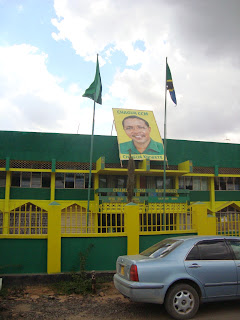 |
| The HQ for the Chama Cha Mapinduzi (CCM) party for the Iringa Region. That guy is President Kikwete. |
Subscribe to:
Posts (Atom)


